History
The size of the River Ivel catchment is a surprise to most people. The Ivel itself runs north from Baldock (N.Herts) to Tempsford (Beds), where it joins the River Great Ouse. Along the way, many smaller tributaries join the River Ivel. These include the Flit, Hit, Hiz, Pix, and Purwell.
The River Ivel catchment includes the towns of Hitchin, Letchworth, Baldock, Stotfold, Flitwick, Ampthill, Shefford, Biggleswade, and Sandy. A pollution spill in the rivers or brooks running though any of these urban centres will eventually impact the River Ivel.
RevIvel needs the help of its members to raise the awareness of the plight of the Ivel across the entire River Ivel catchment area. If you have friends and family living within the catchment area, please ask them to consider joining a local river group. Thank you.
Baldock in the 19th Century, the story of its water & sewage up to 1870
As Baldock entered the 19th Century the town was home to about 1280 people, a slightly smaller population than Walkern, has today. Much of the population made its living from servicing the horse drawn traffic along the Great North Road that ran through the town. Malting & breweries, and farming employed nearly everybody else.
The town drew its water supply from the underlying chalk aquifers using wells & pumps, which can be seen marked on following Ordnance Survey map from 1871 of the town. These wells were from 12 feet to 50 deep, getting steady deeper, the further up the High Street they were located. The pumps shown on the map are located furthest from the Ivel Springs and were generally the deepest of the wells.
Besides the water for people, there were between 600 and 900 horses kept in stables attached to the many coaching inns in the town who also required drinking water. The daily water required for animals may have exceeded the daily requirement for people. Breweries were also major users of water.
Evidence given at the River Pollution Enquiry on Thursday 20th April 1871 describes how “The town is supplied with water by wells and pumps. We find the water from about 10 to 40 feet. I use 20 or 30 gallons a-day for my family.”
With the town’s water supply dependent on the chalk aquifers, which experience cyclical annual fluctuations between summer & winter flow, water was often short in summer. The following article from the Hertford Mercury in November 1848 demonstrates just how tight the water supply in Baldock often was.
“Both engines were upon the spot [Mr Davis’s barn] in less than twenty minutes after the fire broke out, and the smaller one in less than ten minutes, and they were at work within a quarter of hour of the time they reached the spot; but the wells were so shallow that they did not afford a supply of water for more than a few minutes at a time.
Several of the wells were pumped dry during the first half hour the engines arrived, and a considerable time elapsed after their arrival before a continuous supply of water was obtained from a well at a considerable distance from the fire, and when that was obtained the fire was gradually got under.”
Until about 1800 there were little if any infrastructure within the town to deal with human & animal wastes. Animal wastes were a very valuable resource, and it known that horse muck was collected by farmers from neighbouring farms including Quickswood, who spread it on the fields to fertilise their arable crops. The urine simply soaked away into the ground. From 1800 onwards in the larger houses water closets began to be installed, and cesspit pits began to be constructed. During the taking of evidence for the River Pollution Commission in 1871, the following evidence for the “sewage system” as it existed before 1850 was recorded.
“Wm. Richardson, carpenter and builder, of Baldock: I remember the decree for the water-closets being cut off. I cut off as many twenty of them. I should think that fifty were cut off. I don’t think any are not cut off.
The sewers were put in before I went into business. I don’t recollect the first sewer being made. I should think they were built 60 or 70 years ago. I remember a pond in the field at the lower end of the town. There is connection between the pond and the sewer; it has been dry for some years. I am not aware that the sewage ever went into the pond. I made cesspools, cut in the chalk rock; there is no brickwork; I have made them years ago; I could name one without referring to my book; I made my own 25 years ago; it is eight feet deep, and four feet by three feet. I empty it once in three years. I use it for manure. I frequently empty other peoples. It is perfectly dry when emptied. We have overflow from these cesspools. My well is within 20 feet of the cesspool; it is 28 feet deep, the water rising 8 to 10 feet; when it is at its height we have about 18 feet to draw it. Our wells run from 12 feet to 50. We draw the water from level spring. The adjoining house is Mr. Thoday’s. There is a cesspool within or 8 feet of the well, which does not affect the well.”
Up until 1848 (see Figure 3.) the conditions remained relatively benign, as the population was small, and the flow into the River Ivel was unrestricted and only had relatively low flows that the ground water from Ivel Springs was able to dilute.
In 1848 construction of the London to Cambridge through Baldock commenced. The railway line through Baldock required the building of a railway embankment that was to have disastrous effects on the future health of the Baldock community. This was because the embankment’s foundations extended for several metres into the ground, acting as a semi permeable dam, that prevented the surface water and sewage soaking through the ground from reaching the Ivel Springs.
The population of Baldock had also grown by 58% by 1871, as many poor people from nearby villages moved into the town, mainly into the poorest houses at the bottom of Norton Lane and along Deadman’s Lane (as Icknield Street was known).
“By the Commissioner; The population of Baldock in 1851 was 1971; in 1871, 2031). The area is 143 acres. Three or four hundred persons belonging to other parishes live in our parish. Their drainage unites with us. The rateable value of the parish is £5,074. We collect about 6d. in the pound for poor and gas, The town is supplied with water by wells and pumps. We find the water from about 10 to 40 feet. I use 20 or 30 gallons a-day for my family. The water closets were not done away with. The cesspools have never been cleaned out.”
Local government in the town was in the hands of the parish vestry and county authorities and was run by the Rector. In 1850 the Rector was Rev. Thomas Rigby Kewley (1821-1885), and he and his fellow vestry members were soon faced with a very serious public health disaster.
“Sheweth, —That the river Ivel or Rhee rises by numerous springs of most excellent water at spot on the borders of the parish of Bygrave, in the county of Herts., adjoining on its north side the embankment of the railway from Hitchin to Cambridge, and till within a recent period the stream was perfectly pure, and its use freely enjoyed by the occupiers of the numerous mills upon the river and the neighbouring district.
“On the south side of the railway embankment and a few hundred yards from it is situate the town of Baldock. Twenty years ago, or thereabouts, the vestry, or the sewer authorities of the parish of Baldock, constructed a sewer from the town, which is carried under the railway embankment into an open ditch in the neighbourhood of the springs, and subsequently the vestry, or sewer authorities, constructed a second sewer, which is also curled under the railway embankment into open ditch adjoining the springs.
By means of these sewers the sewage of the town of Baldock has ever since been conveyed into the springs, and thereby the river has become greatly polluted and a great nuisance created to the serious injury of your memorialists and others. From this cause the water in the river has gradually become so offensive that for many years it has been unfit for drinking purposes, and latterly also for culinary and other domestic purposes at the mills and the neighbourhood of the upper part of the river, and to obtain wholesome water deep wells have had to be sunk, some instances at considerable expense.
Great inconvenience and suffering is also experienced from the poisonous smell of the water, and the effluvium from the scum which rises on the mill pools and collects above the mill wheels, and these at times, when the wind is in particular quarters, are so offensive at the mills as to render it necessary to close all the windows, and the illness of some of the inmates has been by medical men, to their exposure these injurious influences.”
The experience of people living in the villages of Norton, Radwell & Stotfold, became awful, especially during summer low water flows.
“Mr. Charles Christian, owner and occupier of Norton Mill, deposed: I am owner and occupier of the Norton Mill, the second mill on the river Ivel. It is about half a mile below the springs. I have been owner and occupier since 1862. When I came there the water was foul, but not so bad as it is now. The river was full of weeds. It was offensive. I don’t think it was so bad now. It has continued offensive ever since. There has been no perceptible improvement since, except that I have never smelt it so bad as it has been this winter. I use the water, except for mill purposes, for watering the garden and for the horses to drink. I have lived at the mill four years. I have had to sink well when I built my house. I sunk my well in the kitchen, about twelve feet deep. We have ten feet fall. The well goes into the chalk, which is the lower strata. This is from the level of the ground. It would be 15 feet below the mill head. I raise the water by a pump. I use that water for all purposes. It is not quite good. I think it is stained by iron. We seldom drink it without boiling. I think it is connected with the stream. It tastes and smells nasty. It is 25 feet from the river. There was a heavy storm four or five years ago, in the summer, and the mill head at Mr. Iredale’s overflowed. The water came into the ditch at the back of my house. There is a spring near Mr. Iredale’s, which runs into that ditch, which runs about four or five feet from my well. On that occasion the water in my well was polluted, so that we could not use it at all. I attributed that to it passing out of the ditch. I pumped my well dry two or three times. After doing that the water was in its former condition. That was when the overflow had subsided. I have, a few times since, when Mr. Iredale’s mill head overflowed, found my well polluted. In the mill and outside the water at the mill head is offensive when the mill is at work. There certain accumulation scum, of nasty, offensive stench. We get some of it out with a rake, and use it as manure, to get rid of the nuisance. We should not be able to bear the place from the manure if did not take it off. There are three breweries at Baldock, which are large. There are extensive washings of barrels, which come down the mill head. We see a good many corks coming down. There is direct communication between the breweries and the river. I, with Mr Flitton, visited the springs three or four years ago. We examined the ditch into which the sewer runs through Bygrave. The contents of the sewers from Baldock come by two culverts under the railway. We visited the ditch into which the eastern sewer enters. It was filled with foul sewage of some depth. It was deep, and was penned up with pieces of wood. I think we went twice. I went with Mr. Fletton and yourself. I have frequently visited the spring head, and have seen the foul water flowing into the fresh water. I have seen the dark and clear water running side by side for some distance.”
By 1870 serious outbreaks of water borne diseases were occurring within the town, caused by the pool of effluent that was present, on the surface, or just beneath it, that was polluting all of the drinking water supplies in the lowest lying and houses occupied by the poorest members of the community.
Produced by Nicholas Balmer March 2022
Twelve watermills were still reported operating on the River Ivel from the 1880s to early 1900s. It must have been one of the highest concentrations of mills in the area.
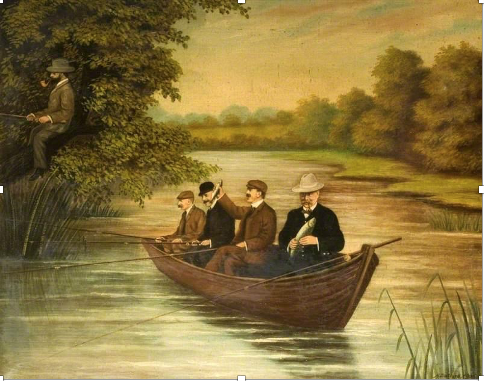
Fishing for Trout at Norton Fisheries near Baldock, painted by Henry Bullard in 1906.
Reproduced with permission copyright Baldock Museum.
This painting contains portraits of local men. Unfortunately their names have been lost. They are fishing on a part of the River Ivel which has been dammed to form a lake for trout. This was part of the property of a company known as Norton Fisheries which operated along the river between Baldock and Radwell tasing trout in hatcheries and fry ponds and growing them in screened parts of the river.
Summary
The sections of the Ivel discussed here are from the river source at Ivel Springs, just north of Baldock down to Stotfold Mill, a distance of 3.65 Km. The first 2.5 Km from Ivel Springs to just below Radwell Mill the river can be described as a “Classic chalk stream”1 with clear warm water, below that it flows out onto the clay and becomes increasingly turbid from runoff. There are several main sources for historical evidence of flow: watercress beds, mills and fisheries, which were, or are, on this stretch of river. The minimum perennial flow required by all three operations was 5 Ml/day, and 14 Ml / day for the mills further downstream.
Watercress beds
Both the Ordnance Survey 18802 and 1892-19143 25 inch maps show extensive watercress beds immediately below Ivel Springs. These were probably built in about 1850 after the railway line came to Baldock which enabled fresh cress to be easily transported to the London markets daily. Watercress was known as ‘the poor man’s bread’4.
The Ordnance Survey 1:10560 maps of 1949 – 69 shows the “Old watercress Beds” 5 so it can be
assumed they existed for about 100 years. Measured in a GIS mapping application, the area of the beds in about 1900 was 2.0952 Ha or 5.117 Acres.
Table 1 shows from a range of sources the average flow required for this size of beds, which was
was a little over 5 Ml / day.
Water Mills
There are 4 water mills on this stretch of the river. Blackhorse Mill, Norton Mill, Radwell Mill and
Stotfold Mill. The latter two get a mention in the Domesday book 9. Baldock in its current form was established after 1086 so Blackhorse Mill may have been the one mentioned in Weston 10, which covered that land at the time, but this is uncertain. It certainly was a substantial mill structure by 1760 11.
In any case it is possible to say there have been mills on this stretch of the Ivel for at least 1000 years. Before the railway came it was not easy to transport heavy or bulky goods great distances. These mills were a critical infrastructure which relied on a constant flow of water to make staple foodstuff out of local grain for local people all year round.
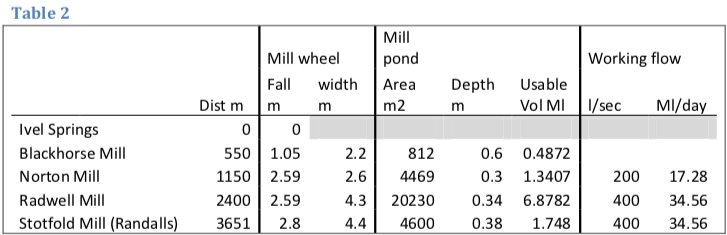
With reference to table 2, both Radwell mill and Stotfold mill are of a size to run 2 stones @ c.15 Hp which required c. 400 l/sec. 12 It seems unlikely the river ever had a flow like this, but that is the reason for Radwell Mill pond, which has a reserve capacity of about 7 Ml. If the incoming flow was at least 165 l/sec or 14 Ml/day the miller would be able to run at full power for 8 hours without depleting the reserve, and it would have refilled before work started the next day.
Stotfold Mill has a much smaller reserve, and it takes about 1 1/2 hours for water to travel between them, so if both mills started work at about the same time the slug of water from Radwell would be arriving just as Stotfold’s own reserve was running out. Both mills could work the same hours and were both dependent on a flow equivalent to about 14 Ml/day at Radwell.
Same as Radwell or Stotfold, Norton Mill had an overshot wheel with about the same fall, but was much narrower and was probably only capable of running one stone. Nevertheless, this would still have required a continuous flow of at least 7 Ml/day which is entirely possible because the springs at
Nortonbury were also a very active source, A Garden City document of 1904 says: Constant springs are found at Nortonbury and Baldock 13 . Norton Mill has quite a large pond, and it was probably linked to the old moat and pond at Nortonbury Farmhouse 14 which today has almost completely gone, but it was a substantial body of water. It is entirely reasonable to think Nortonbury Springs and Ivel Springs combined could have supplied 7 – 10 Ml/day to Norton Mill.
Blackhorse mill had much less fall than the others, and likely had a breastshot or undershot wheel so it probably wasn’t very efficient which explains why it was the first to fall into disuse as a mill in the middle of the 19th Century. As industrialisation increased through the late 19th century even the efficient local mills lost their competitiveness, but there was still plenty of water, so both Norton Mill and Radwell Mill became fisheries, but it appears they ceased operation in about 1915, probably because of the war. Stotfold Mill continued operating as a mill until the 1960’s. It was restored in the early 2000’s and is operating again as a museum 15.
Fisheries
A Letchworth Garden City document of 1903 says: At Norton mill there is an establishment for fish culture, where all kinds of trout are hatched and reared, and where advice may be obtained as to stocking of lakes, rivers Etc. The extensive trout fisheries at Radwell were also built at about that time and are still shown on the map today.16 Both would have needed the sort of continuous flow of clean water the mills had – and we never see today.
There is more work to do: The Hertfordshire county archives contain much useful information about the Ivel, most of which we have yet to see. For example there is a substantial body of papers relating to the case in 1904 of Cookson and others (from Norton & Radwell fisheries) v Baldock Urban District Council over the alleged poisoning of fish as the result of a sewage overflow caused by two sequential thunderstorms, some human error, and the failure of a pump. It took 3 years, but the fisheries won a substantial compensation. We have found references to river flow data included in the case evidence, but not the data itself – yet.
References
1 Smith et al 2003 Water & Environmental Management Journal, A method to identify chalk rivers and assess their nature conservation value.
2 Garden city Heritage collection: http://www.gardencitycollection.com/object-plan919
3 National Library of Scotland https://maps.nls.uk/geo/explore/side-by- side/swipe/#zoom=17&lat=51.99672&lon=-0.18893&layers=168&right=BingHyb
4 http://www.missfoodwise.com/2013/06/british-watercress-and-poor-mans-bread.html/ 5 National Library of Scotland https://maps.nls.uk/geo/explore/side-by- side/swipe/#zoom=17&lat=51.99672&lon=-0.18893&layers=193&right=BingHyb
6 Email correspondence with a leading watercress grower
7 History of Harpenden watercress beds http://www.harpenden-history.org.uk/page_id__55.aspx
8 Environment Agency paper 2009 Watercress growing and its environmental impacts on chalk rivers in England (NECR027) http://publications.naturalengland.org.uk/publication/40010
9 Opendomesday; Radwell https://opendomesday.org/place/TL2335/radwell/ Stotfold: https://opendomesday.org/place/TL2136/stotfold/
10 Opendomesday: https://opendomesday.org/place/TL2530/weston/
11 http://www.gardencitycollection.com/object-lbm3000-47
12 Fall (in metres) x Flow (litres per second) x Gravity 9.81 = Power (Watts).
13. http://www.gardencitycollection.com/object-lbm3058-7-14
14 http://www.gardencitycollection.com/object-2007-60-9
15 https://www.stotfoldmill.com/
16 https://maps.nls.uk/geo/explore/side-by-side/swipe/#zoom=17&lat=52.00739&lon=- 0.20475&layers=10&right=BingHyb
Richard Meredith Hardy
June 2020
Upper reaches of the River Ivel – Too Little Rain or Too Much Abstraction?
The Ivel springs rise on the northern edge of Baldock and the river flows in a northwest direction towards the villages of Norton, and Radwell.
In 1901, Baldock was a small rural market town with a population of two thousand and fifty-seven people. The economy relied on the brewing industry and agriculture. The water supply for the Baldock townsfolk was primarily via local wells.
The Parishes of Letchworth and Norton were sparsely populated with less than 200 people living on the land purchased by the First Garden City in 1903.
Water abstraction to supply a growing population
The first borehole was sunk in 1904 to serve Letchworth Garden City.
Water supply to Baldock via the borehole commenced in 1906.
By 1935, six boreholes had been sunk with capacity to supply 220,000 gallon/hr (or 1.0ML/hr). At this time the combined population of LGC and Baldock was approximately 18,000.
The population of LGC and Baldock continued to grow up to 1961 (32,275 people). Between 1935 and 1961, the population increased by 80%. It is reasonable to assume that water consumption also increased by 80% over this time frame.
The First Garden City Ltd managed the water supply until 1960 when The Lee Valley Water Company was formed as of 1 April 1960.
The current valid abstraction license was established in 1966 (dated Aug 1966) 6/33/14/*G/0010 (incorporating Baldock Road, Letchworth, Bowring, Letchworth and Fuller, Letchworth).
The current licence authorises abstraction of 5,391,675 cubic metres per year (maximum of 20.46 Ml in any 24 hour and a daily average of 14.77 Ml/d (over 365 days).
Population Growth Throughout the Twentieth Century:
Letchworth Garden City
Letchworth Garden City was established in 1903 when the village of Letchworth, and land from the parishes of Norton and Willian were purchased by the First Garden City Ltd.
Letchworth Garden City was designed with a maximum population of thirty-two thousand in mind. The town grew steadily with the model population reached in 1991 and by 2019 the population had further increased, estimated to be just over thirty-four thousand (34,000).
Baldock
The population of Baldock started to grow in the 1930’s with further development in the 1950’s. Significant population increase occurred in the mid 1980’s with the development of Clothall Common estate. The current population is estimated to be ten thousand, six hundred and twenty-four (10,624).
Current Map of Letchworth, Baldock and Surrounding Area 2021.
Future Population Growth Anticipated with the NHDC Local plan 2011-2031:
The combined population of LGC and Baldock in 2019 was just under 45,000 people.
The Local Plan has provision for an increase for 2167 houses in Letchworth Garden City up to 2031. In Baldock there are significant expansion plans with up to 3298 extra houses planned. Since there are currently 4500 residential units catering for 10,624 people today in Baldock, it is reasonable to assume a similar population density and house occupancy for the future in the towns of LGC and Baldock. Thus, we can assume a population increase in the order of 12,500, bringing the combined population to 57,680 by 2031.
Water consumption per capita has increased considerably over time. In the 1860’s and before mains water supplies then water consumption per person was approx 36 l/day. By the 1960s, this had increased to 85l/day. In recent decades water consumption has increased considerably, driven primarily by an increase in the use of showers, baths, and increased use of household appliances such as dishwashers and washing machines.
Supplying water to this ever-increasing population and preserving water flow in the upper reaches of this precious chalk river is a major challenge. Current water consumption in the UK is 149l/day for a single person household. Affinity Water supply area is consistently one of the worst in terms of consumption per person with 2016/7 water consumption at 152/day.
Affinity Water currently abstract on average 14.77 ML/day from the Baldock Road, Bowring and Fuller boreholes (6/33/14/*G/0010) and in many months of the year exceed this level to serve a current population of 45,000 people in LGC and Baldock.
By 2031, when the population exceeds 57,500 people, alternative water sources must be found.
NIAB Cambridge monthly rainfall (mm) over 30 years-
Over the thirty year period ( 1991-2020) we see seasonal variation but no overall reduction in rainfall in autumn and winter “recharge months”.
So we can confidently say the lack of water in the River Ivel is down to OVER ABSTRACTION.
Affinity Water Abstraction is Detrimental to the River Ivel.
Abstraction licence was granted on 21st Aug 1966 (Great Ouse River Authority).
In the 1990’s abstraction in the range 8-10 million litres per day.In early 2000’s this increased to 12 Million Litres/Day.
Abstraction increased even further from 2008 onwards to the maximum licensed level.
Baldock Road, Bowring and Fuller 6/33/14/*G/0010 currently authorises 5,391,675 cubic metres per year
Affinity Water operates this licence close to full licensed quantities in normal years i.e. maximum of 20.46 Ml in any 24 hour period and an average of 14.77 Ml/d.
However, in drought or dry conditions the level of the groundwater table reduces their ability to abstract!
2005-2007 and 2011-2012 are examples of years when Affinity Water were forced to reduce abstraction because there was insufficient water!
River Ivel at Iron Bridge, Radwell – Summer 1983 when water abstraction was approx 8-10 Million litres/day.
Could we see this coming? – Yes!
NIAB Cambridge monthly rainfall (mm) 2016-2020
Three winters with low recharge (autumn 2016- spring 2019) and unabated abstraction directly lead to the catastrophic event in summer 2018 – Nov 2019 when up to 2.5km of the River Ivel ran dry and DIED.
Affinity Water Data – Surface Water Flow monitoring- 2.5Km stretch of Ivel from source clearly under severe “stress”from June 2018 onwards……only recovering in Dec 2019.
Surface water flow fluctuates according to the GroundWater variation denoting a classic Chalk river
The perennial spring head at Ivel springs to Radwell Lodge was dry from August 2018 until November 2019.
All this under the management of Affinity Water and under the nose of The Environment Agency.
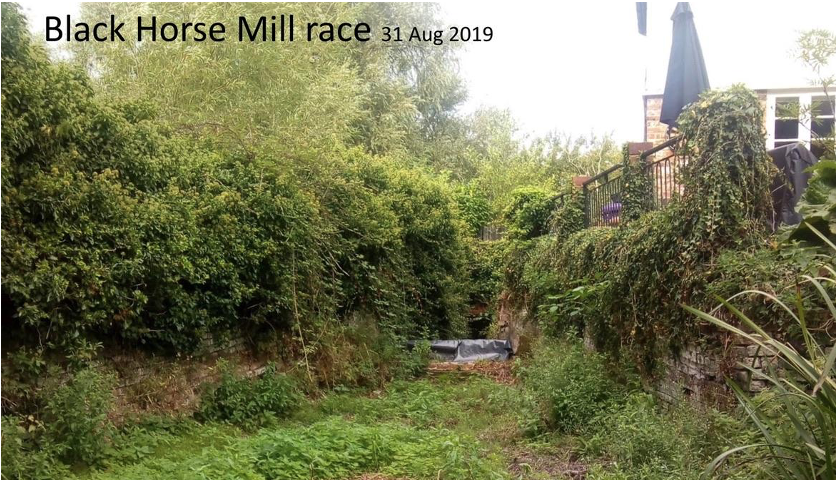
Zero flow at Black Horse Mill Aug 2019.
“Dead” Chalk River at Radwell (2.5 km from source in River Ivel) in September 2019
If the Environment Agency model shows the catchment to be “below average” in a year when they allow a chalk river to dry up for 2.5 km from its spring source, then the model clearly fails to reflect the reality on the upper Ivel.
The EA should aim to manage a resilient and sustainable chalk aquifer to ensure year-round flow of the River Ivel.
The headwaters of the River Ivel have been under severe stress for decades.
Status of Spring flow – Nov 2021
Despite a high level of winter recharge in autumn/ winter 2020/21 the perennial spring head (spring 1) in the Ivel Spring nature reserve has been dry from August 2021 – Nov 2021.
Flow is still seen at spring 2 (Spring Drain).
Affinity Water data – up to Sept 2021
Upper reaches of the River Ivel at risk from Over-Abstraction
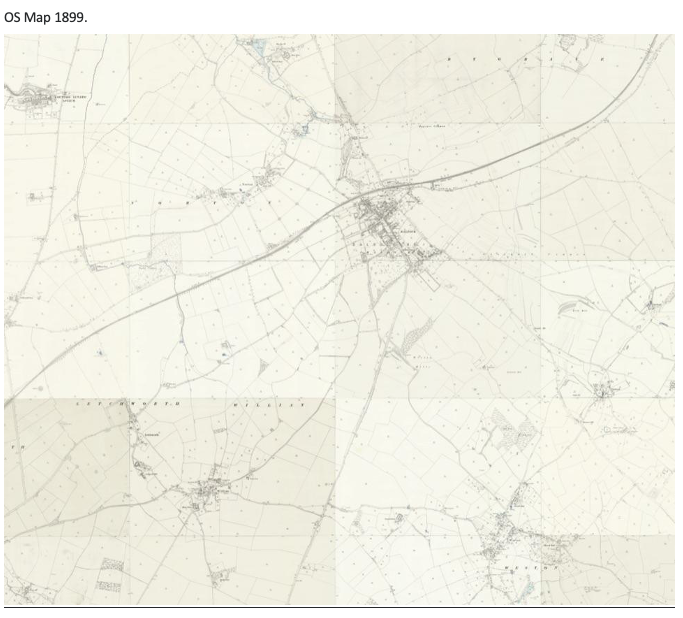
OS Map (1899-1913)
Watercress Production in Baldock
Traditional method
Traditional watercress growers are defined by Environment Agency licensing requirements as growers who would replant their beds no more than once a year between the beginning of June and the end of September. Most cleaning and re-sowing takes place between March and July.
Watercress is grown in shallow gravel beds fed by springs and bore-holes, which provide a constant flow of relatively warm, pure, chalk-filtered spring water.
Watercress is either grown from seed or through vegetative propagation. At the start of the UK season, watercress seeds are propagated on thin layers of compost within greenhouses and poly-tunnels.
After about 7 to 10 days, the seedlings are transplanted into the gravel beds outside.
Pure spring water is introduced to the crop, gently at first and then in ever increasing volumes with a mature bed needing an average of 5,000 gallons per acre per hour.
The growing time can be anything from 28 to 70 days depending on the weather.
Traditionally watercress was considered a winter crop, harvested during months with a R (September to April). (Jonathan Cox, 2009)
Watercress production in Baldock:
Watercress growing on stretches of chalk rivers developed from 1850 onwards. The growing population of London was hungry for fresh vegetables/salads and watercress offered a nutritious crop through autumn and winter months. The expansion of the railways made transportation to London quick and easy. In Victorian Britain it was called ‘the poor man’s bread’, it provided the working class with a good portion of nutrition for the day and became one of the first foods for on-the-go.
UK census records at Blackhorse Mill in 1891 and 1901 identify James Frederick Moody as a watercress grower.
An OS 25 Inch map dated 1892-1914 illustrates the Baldock watercress beds. (National Library of Scotland OS 25 Inch, 1892-1914). These were managed by Mr Moody during this period. Whilst the local historical society states the watercress beds cover a 12 acres area, detailed measurements of the watercress beds themselves shows an area of 5.177acres / 2.0952Ha.
The Baldock watercress beds required up to 5ML/day spring water and would have produced watercress from September to April.
The water cress beds were operational in pre-WW2 period but were stated as redundant by 1949.
References:
- Watercress Growing and its Environmental Impact on Chalk Rivers in England.NECR027 Oct 2009. Jonathan Cox,2009
- UK Census record 1891
- UK Census record 1901
- National Library of Scotland -OS 25 Inch series, Great Britain 1892-1914
- Email correspondence with a leading watercress grower
- History of Harpenden watercress beds http://www.harpenden-history.org.uk/page_id__55.aspx
Water Mills and Fisheries on the upper reaches of the River Ivel.
The sections of the Ivel discussed here are from the river source at Ivel Springs, just north of Baldock down to Stotfold Mill, a distance of 3.65 Km. The first 2.5 Km from Ivel Springs to just below Radwell Mill the river can be described as a “classic chalk stream” with clear steady temperature water, below that it flows out onto the clay and becomes increasingly turbid from runoff.
There are 4 water mills on this stretch of the river. Blackhorse Mill, Norton Mill, Radwell Mill and Stotfold Mill. According to Domesday records, there have been mills on this stretch of the Ivel for at least 900 years.
Before the railway came it was not easy to transport heavy or bulky goods great distances. These mills were a critical infrastructure which relied on a constant flow of water to make staple foodstuff out of local grain for local people all year round.
Blackhorse Mill, Bygrave/Baldock
Extract from A History of the County of Hertford: Volume 3. Bygrave pp 211-217. Originally published by Victoria County History, London, 1912.
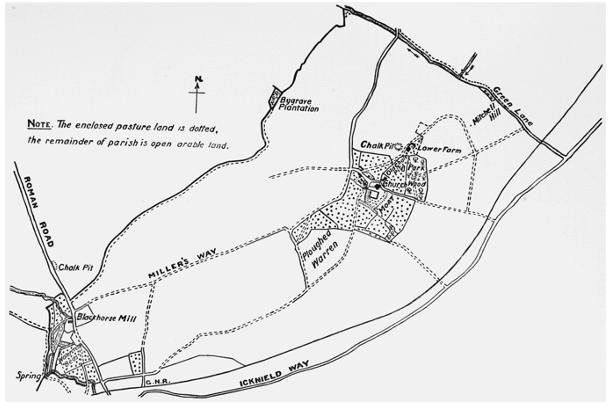
Near Baldock a small portion of Bygrave parish lies to the west of the North Road. It consists of some rough pasture, water-cress beds and rush-grown waste, and is traversed by the River Ivel. This extension over the Roman road was made by the early settlers with the object of obtaining the waterpower from the Ivel to drive the manorial mill. The pathway from the village which comes into the Roman road near to Blackhorse Farm or Blackhorse Mill is still known as Miller’s Way.
In 1086, The Domesday Survey recorded one water mill at Bygrave assessed as worth 10s.
The land west of the Great North Road (roman road) was transferred to Baldock Parish in 1881.
Blackhorse Mill was made famous in 1743 when a ballad was penned describing “The Lass of Baldock Mill” who was famed for her beauty. (The Gentleman’s Magazine, 1743).
Blackhorse Mill (Baldock Mill), Chapman, 1787
According to the UK census 1841 Blackhorse Mill was operating in the 1840’s under the management of William Bishop. It ceased to operate as a mill in the middle of the 19th Century thereafter the focus of attention turned to watercress production.
Norton and Norton Mill:
Extract from “A history of the county of Hertfordshire”,1908:
In the north and east of the parish cornfields cover the higher slopes, while on the lower levels the little River Ivel, fed by springs and marking the eastern boundary of the parish, winds slowly through swampy meadows. Watercress used to be much grown here, but competition has spoiled the market. Other springs near fill the manor moat and uniting into another stream flow into the Ivel.
In the Domesday Book (1086) there was mention of two mills in Norton and Norton Mill remained fully operation up until 1902.
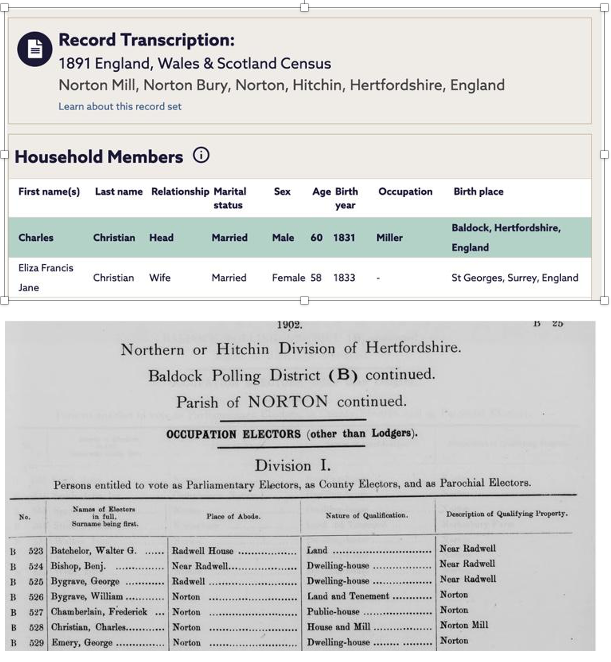
Census and local electoral documents identify Charles Christian as a Master Corn Miller, living and working at the Norton Mill, from 1871 until 1902.
.
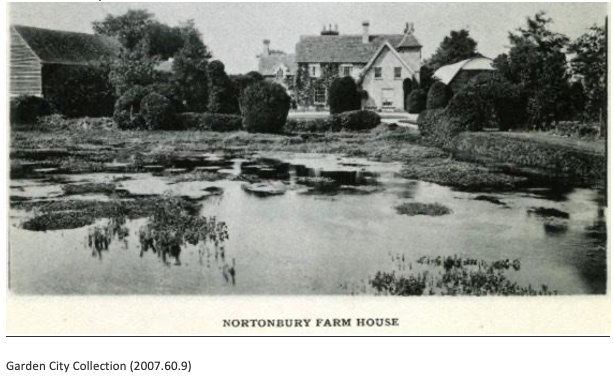
Nortonbury Farmhouse – showing a large pond (1903-05)
A Garden City document of 1904 says: Constant springs are found at Nortonbury. (Garden City Collection – lbm3058-7-14). Norton Mill has quite a large pond, and it was previously linked to the old moat and pond at Nortonbury Farmhouse which today has almost completely gone, but it was a substantial body of water.
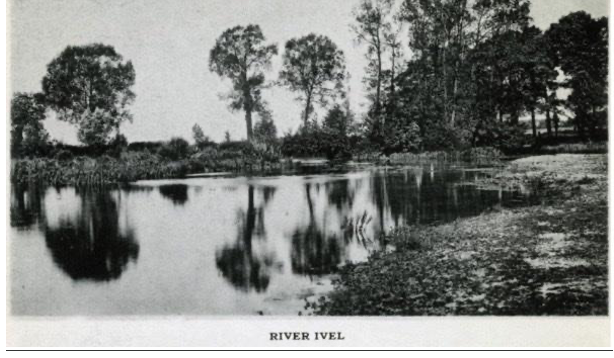
Stretch of the River Ivel near Norton (1903-1905)
Garden City Collection (2007.60.9)
Norton Fisheries
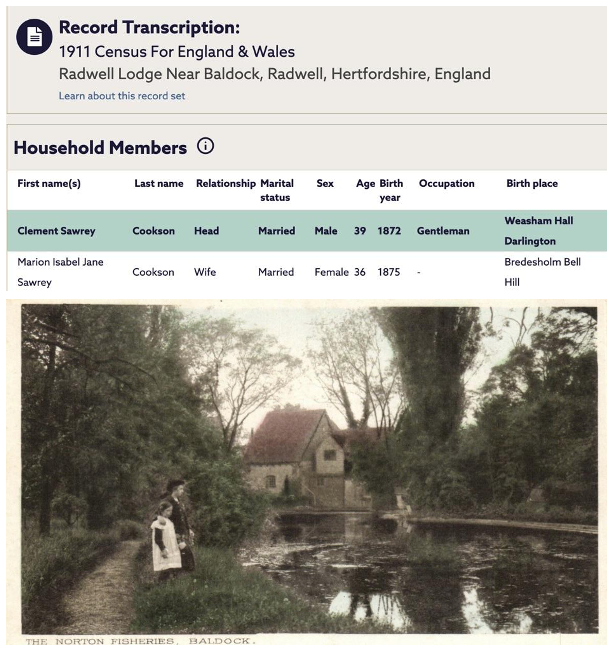
In 1904 Messrs. Lothian and Clement Sawrey-Cookson purchased rights to operate a trout-rearing and fisheries operation on the river Ivel between Norton and Radwell called Norton Fisheries. Clement Sawrey-Cookson was a gentleman who lived at Radwell Lodge and owned Norton House (1904-1915). The fishery ceased commercial operation in about 1915, probably because of the First World War.
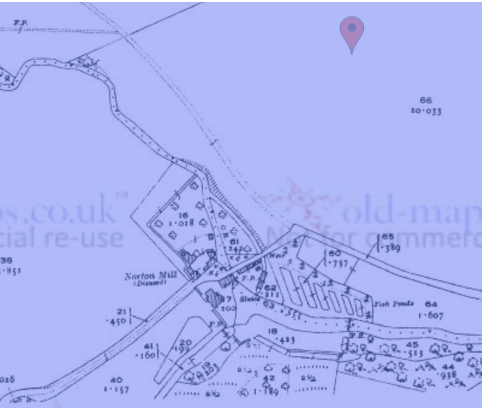
OS County Series 1922 – Bedfordshire (partial), 1:2,500. Map showing the trout rearing fishponds
Painting:Fishing for Trout at Norton Fisheries (1906)
Norton Fisheries operated along the river between Baldock and Radwell raising trout in hatcheries and fry ponds and growing them in screened parts of the river.
Trout Fishery workers living on North Road.
Radwell Mill
A History of the County of Hertford: Volume 3 Radwell. Originally published by Victoria County History, London,1912.
In the reign of “Edward the Confessor” and in the early days after the Conquest there were two manors in Radwell. The Domesday Survey noted that the larger manor was assessed at 4 hides and had a mill attached worth 8s. The smaller manor in Radwell was assessed in 1086 at only 2 hides and had a mill worth 6s. 8d.
In 1650 Sir Robert Berkeley sold the manor to Thomas Cole, citizen and merchant tailor, of London. The sale included a water corn mill, all watercourses, floodgates and dams on the manor, the liberty of a swanmark, or of keeping swans in or near Radwell, court leet and court baron. Thomas Cole continued to hold the manor until 1677, when he sold it to Robert Bell. Radwell remained in this family until 1720–1 when It was purchased by William Pym of Nortonbury.
According to the UK Census 1851 Radwell mill was operated by Richard Christy, employing 4 men.
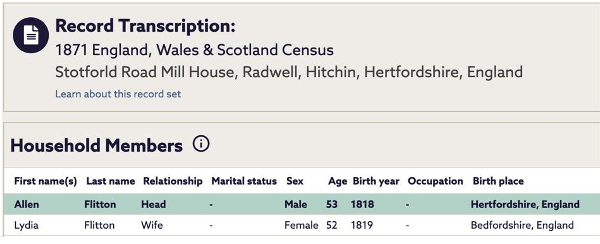
In 1866 a legal case by the owner (Mills) & the tenant (Allen Flitton) of Radwell Mill to restrain the churchwardens and overseers of Baldock from polluting the river with sewage, so bad that “no fish can live therein” (Mills v Bally Nov 1866). Note the river is named Rhee in this case, but is clearly the Ivel
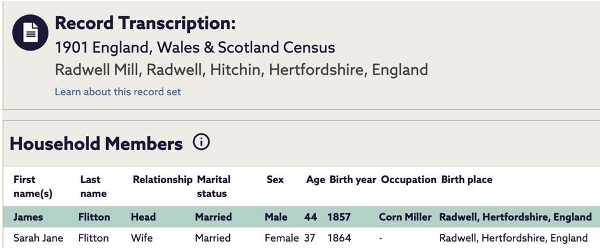
By 1901, the UK Census identified James Flitton as the Corn Miller at Radwell Mill.
A map of Radwell, showing Radwell Watermill and Millpond, OS 25 Inch map, 1892-1914
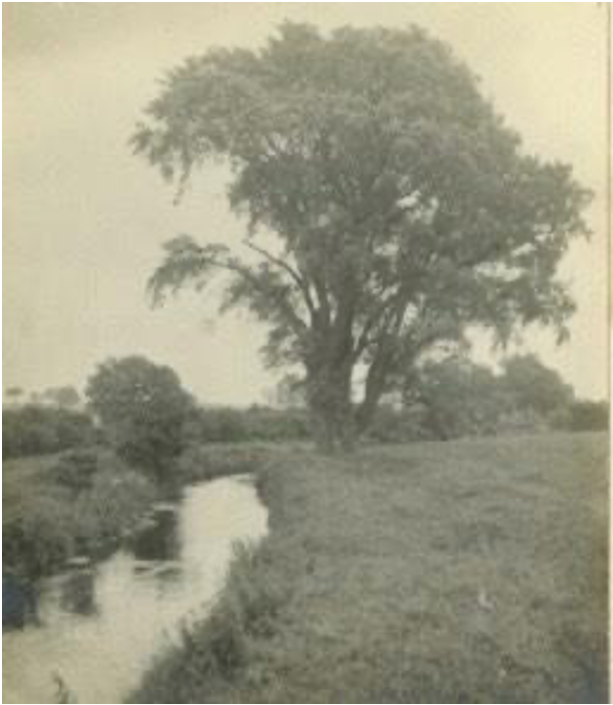
Photograph of River Ivel at Radwell, 1920.
Garden City Collection (lbm3058-7-14)
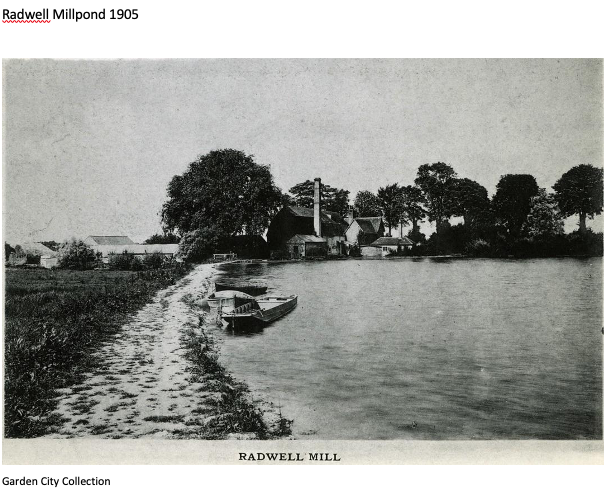
Radwell Millpond 1905
Stotfold Mill
Stotfold pp 300-304 A History of the County of Bedford: Volume 2. Originally published by Victoria County History, London, 1908.
In the Domesday book of 1086 four water mills were identified in Stotfold. One of those four was the currently named Stotfold Mill. The combined rents, payable to Hugh de Beauchamp, Baron of Bedford was £4.
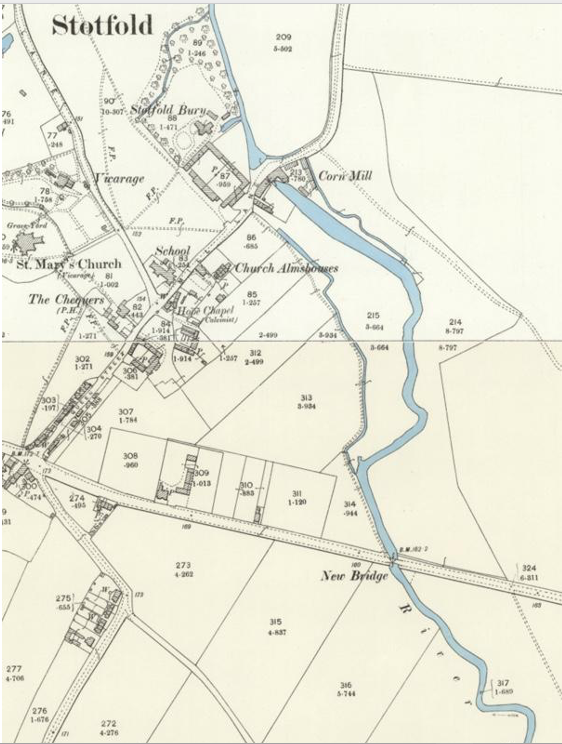
OS Map 25 Inch 1892-1914 – Map showing River Ivel at Stotfold Mill
Stotfold MiIl was in continuous operation for over 900 years The Randall family were the last milling dynasty operating the mill from 1872 until 1966.
The Stotfold Mill Preservation Trust was set up as a charity to restore the Mill to working condition and transform the adjoining meadows into a nature reserve. In 2006, after many years of dedicated work by volunteers and specialists, corn was once again ground in Stotfold Mill. The Nature Reserve was officially opened in June 2011. (Stotfold Mill).
Blackhorse, Norton, Radwell and Stotfold Mill Operating Capacity:
The mills on this stretch of the Ivel operated for at least 900 years and were central to the rural economy. The mills relied on a constant flow of water to make staple foodstuff out of local grain for local people all year round.
Table 1:
With reference to Table 1, both Radwell mill and Stotfold mill are of a size to run 2 stones @ c.15 Hp which required c. 400 l/sec. 12 It is probable the river rarely had a flow like this, but that is the reason for Radwell Mill pond, which has a reserve capacity of about 7 Ml. If the incoming flow was at least 165 l/sec or 14 Ml/day the miller would be able to run at full power for 8 hours without exhausting the reserve, and it would have refilled before work started the next day.
Stotfold Mill has a much smaller reserve, and it takes about 1 1/2 hours for water to travel between them, so if both mills started work at about the same time the slug of water from Radwell would be arriving just as Stotfold’s own reserve was running out. Both mills could work the same hours and were both dependent on a flow equivalent to about 14 Ml/day at Radwell.
Same as Radwell or Stotfold, Norton Mill had an overshot wheel with about the same fall but was much narrower and was probably only capable of running one stone. Nevertheless, this would still have required a continuous flow of at least 7 Ml/day which is entirely possible because the springs at Nortonbury were also a very active source, A Garden City document of 1904 says: Constant springs are found at Nortonbury and Baldock. (Garden City Collection -lbm3058-7-14). Norton Mill has quite a large pond, and it was probably linked to the old moat and pond at Nortonbury Farmhouse which today has almost completely gone, but it was a substantial body of water. It is entirely reasonable to think Nortonbury Springs and Ivel Springs combined could have supplied 7 – 10 Ml/day to Norton Mill.
Blackhorse mill had much less fall than the others, and likely had a breastshot or undershot wheel so it probably wasn’t very efficient which explains why it was the first to fall into disuse as a mill in the middle of the 19th Century. As industrialisation increased through the late 19th century even the most efficient local mills lost their competitiveness.
References:
A History of the County of Hertford: Volume 3. Bygrave pp 211-217. Originally published by Victoria County History, London, 1912.
A History of the County of Hertford: Volume 2. Norton. Originally published by Victoria County History, London, 1908.
A History of the County of Hertford: Volume 3. Radwell pp 244-247. Originally published by Victoria County History, London, 1912.
The Gentleman’s Magazine vol. 13, Poetical Essays; May 1743 p. 267
http://www.gardencitycollection.com/object-lbm3058-7-14
Garden City Collection (2007.60.9) photos
Garden City Collection (lbm3058-7-14) photos
Garden City Collection LBM3000.47
History
UK census records 1851
UK census records1881
UK census records 1891
UK census records 1901
UK census records 1911